


WaveDM.jl: An Adaptable Simulation Framework for Dynamics of Baryonic and Wave Dark Matter on Galaxy Scales
WaveDM.jl is an open-source Julia package for high-performance simulations of wave (fuzzy) dark matter dynamics at galaxy scales. The code solves the time-dependent Schrödinger–Poisson equation (SPE) with a second-order pseudo-spectral split-step Fourier method. Its design philosophy centers on adaptability — making galaxy-scale simulations accessible to a broad range of astrophysicists — and extensibility, so the codebase can grow as a community-oriented project within the Julia ecosystem.
- Coupled wave + N-body evolution of wave dark matter halos and baryonic components (mesh / static / dynamic particles) on the same grid.
- Time-dependent tidal fields from the Milky Way and external perturbers such as the LMC, with backward-in-time satellite trajectories.
-
Multi-level parallel execution: shared-memory multi-threading, distributed-memory (Julia
Distributed.jl), and GPU acceleration (CUDA.jl) — the same script runs from a laptop to a multi-node HPC cluster. - Galaxy-simulation toolbox: gNFW / NFW / Zhao initial-condition generators, Milky-Way mass model (Zhu 2023), MW satellite trajectory lookback (Battaglia 2022), MW/LMC tidal fields, virial and QSS diagnostics, real-time visualization.
-
Cross-disciplinary GNLSE interface — astrophysics, nonlinear optics and cold-atom physics share the same solver through a pluggable potential
$V(\mathbf r, t, \psi)$ .
-
Install Julia ≥ 1.12 from julialang.org.
-
Open Julia, press
]for package mode, then runpkg> add https://github.com/JuliaAstroSim/WaveDM.jl # pkg> add WaveDM # This will be supported soon
-
(Optional) GPU acceleration requires an NVIDIA GPU, the CUDA toolkit, and the
CUDA.jlJulia package.
For development:
git clone https://github.com/JuliaAstroSim/WaveDM.jl.git
cd WaveDM.jl
julia --project -e "using Pkg; Pkg.develop(Pkg.PackageSpec(path='.'))"The shortest useful script: an ultra-faint dwarf (Crater II) under the SPE solver, with the LMC-enabled MW tidal field switched off for a clean virialization:
using WaveDM
using Unitful

simulate_waveDM(;
    model           = :dwarf_UFDs,
    Galaxy_id       = 6,                  # Crater II
    V               = (x, y, z, ψ) -> 0.0,
    Nx              = 384,
    Xmax            = 20u"kpc",
    Tmax            = 6.0u"Gyr",
    autoset_timestep = true,
    gpu             = true,
    Realtime        = true,
    title           = "CraterII",
)
Add the time-dependent MW tidal field, optionally perturbed by the LMC:
simulate_waveDM(;
    model            = :dwarf_UFDs,
    Galaxy_id        = 6,
    V                = (x, y, z, ψ) -> 0.0,
    Nx               = 384,
    Xmax             = 20u"kpc",
    Tmax             = 6.0u"Gyr",
    autoset_timestep = true,
    MW_tidal_field   = true,              # time-dependent MW tidal field
    LMC_tidal_field  = true,              # include the LMC perturbation
    gpu              = true,
    title            = "CraterII_MW_LMC",
)
A halo that has reached virialization in the periodic-domain sense (no MW field) ends up in a tide-driven non-equilibrium state once the live MW tidal field is turned on — a useful diagnostic for stripping studies.
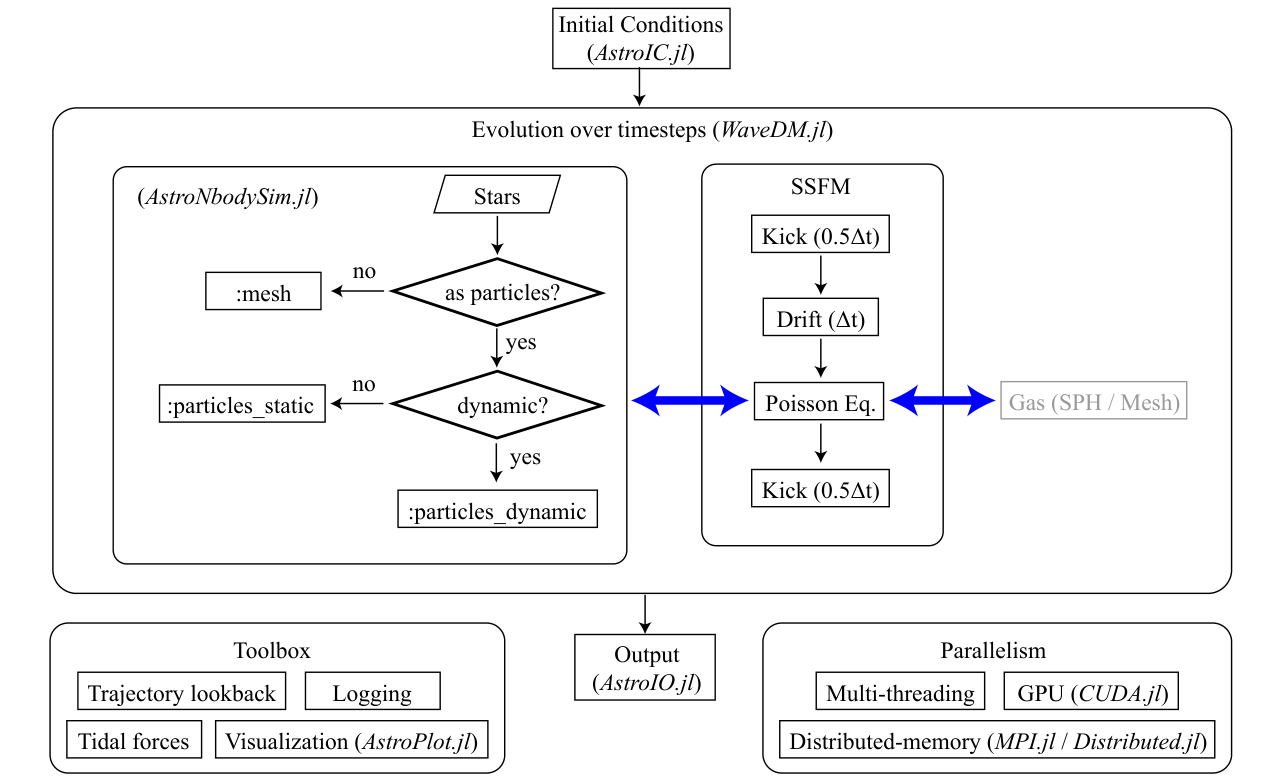
Figure: Architecture of WaveDM.jl (taken from the accompanying paper).
WaveDM.jl integrates four core components on top of the shared JuliaAstroSim infrastructure:
- a pseudo-spectral split-step Fourier method (SSFM) solver for the SPE, evolving
$\psi$ with a second-order kick–drift–kick (KDK) scheme; - an optional baryonic physics module (
AstroNbodySim.jl) with mesh-based and particle-based treatments (baryon_mode = :ignored | :mesh | :particles_static | :particles_dynamic); - a galaxy-simulation toolbox providing trajectory lookback, tidal-field evaluation, virial diagnostics, profile/RC fitting, real-time visualization, and post-processing;
- a multi-level parallel framework combining multi-threading, distributed-memory (
Distributed.jlwith TCP/IP transport), and GPU acceleration (CUDA.jl).
Initial conditions are generated by AstroIC.jl; snapshot I/O is handled by AstroIO.jl. Gas dynamics via SPH is planned for a future release.
The SPE solver evolves the bosonic field AstroNbodySim.jl simultaneously evolves baryonic particles (static or fully dynamic) and computes their gravitational coupling to the wave dark matter. Time-dependent tidal fields from a host halo and external perturbers (e.g. the LMC) are supported. Both DirectSum ($\mathcal{O}(N^2)$) and Tree (
Shared-memory multi-threading, distributed-memory parallelism via Julia's native Distributed.jl, and GPU acceleration via CUDA.jl are all exposed through simple keyword arguments (julia -t N, distributed_memory=true, gpu=true). The same script runs unchanged from a laptop to a multi-node cluster. MPI support is planned for a future release.
using Distributed
addprocs(4)
@everywhere using WaveDM

simulate_waveDM(; Nx = Ny = Nz = 256, distributed_memory = true, gpu = false, ...)Ready-to-use density profiles (gNFW, NFW, Zhao, β-model), the Milky-Way mass model from Zhu et al. (2023), MW-satellite trajectory lookback from Battaglia et al. (2022), MW/LMC tidal fields, on-the-fly virial and energy diagnostics, profile and rotation-curve fitting, and interactive 2D/3D visualization through GLMakie.jl (with terminal-based UnicodePlots.jl for headless runs).
Wave (or "fuzzy") dark matter describes dark matter as an ultralight bosonic field with particle masses
reaches astrophysical scales — comparable to galactic substructure. The macroscopic wavefunction
with
where
An isolated halo with a gNFW initial profile, no baryons, no external tidal field — the cleanest setup for benchmarking the SPE solver:
using WaveDM
using Unitful

simulate_waveDM(;
    model           = :dwarf_UFDs,
    Galaxy_id       = 6,                  # Crater II
    V               = (x, y, z, ψ) -> 0.0,
    Nx              = 384,
    Xmax            = 20u"kpc",
    Tmax            = 6.0u"Gyr",
    autoset_timestep = true,
    gpu             = true,
    Realtime        = true,
)Place the Milky Way's baryons on a fixed N-body background by sampling them with AstroIC.ExponentialDisc and switching to baryon_mode = :particles_static:
using WaveDM, AstroIC
using PhysicalParticles, UnitfulAstro, Unitful

particles_stellar_thin = generate(
    AstroIC.ExponentialDisc(;
        collection   = STAR,
        NumSamples   = 50_000,
        TotalMass    = 3.5e10u"Msun",
        ScaleRadius  = 2.42u"kpc",
        ScaleHeight  = 0.30u"kpc",
    )
)

particles_gas_HI = generate(
    AstroIC.ExponentialDisc(;
        collection   = GAS,
        NumSamples   = 30_000,
        TotalMass    = 8.0e9u"Msun",
        ScaleRadius  = 7.0u"kpc",
        ScaleHeight  = 0.085u"kpc",
        HoleRadius   = 4.0u"kpc",
    )
)

simulate_waveDM(;
    model              = :MW,
    baryon_mode        = :particles_static,
    baryon_particles   = [particles_stellar_thin; particles_gas_HI],
    GravitySolver      = Tree(),
    SofteningLength    = 1.0u"kpc",
    Nx = Ny = Nz = 256,
    Xmax               = 100u"kpc",
    Tmax               = 3.0u"Gyr",
    autoset_timestep   = true,
    gpu                = true,
)
For full coupled evolution (wave DM ↔ baryons), use baryon_mode = :particles_dynamic. See the Examples page in the documentation for more.
The full documentation is available at juliaastrosim.github.io/WaveDM.jl.
- Introduction — wave dark matter background, design philosophy, ecosystem
- Installation — installing WaveDM.jl and its dependencies
- Algorithms — SPE, split-step Fourier method, boundary conditions, resolution and timestep criteria, virial / QSS diagnostics
- API Reference — detailed API documentation
- Examples — end-to-end simulation examples
- References — related literature
- Grid size: powers of two (64, 128, 256, …) maximize FFT performance.
-
GPU: most useful for grids
$\gtrsim 256^3$ ; at large$N \gtrsim 512$ , GPU memory can become the bottleneck. -
Multi-threading: launch with
julia -t Nand enableFFTW.set_num_threads(N)for FFT-bound work. -
Distributed:
addprocs(N)thendistributed_memory = true; usesDistributed.jlwith TCP/IP transport (no MPI dependency). -
Visualization: increase
StepsBetweenSnapshotsto reduce plotting overhead in long runs.
Detailed benchmarks on a 40-core + NVIDIA Tesla P100 node are reported in the accompanying paper.
If you use WaveDM.jl in your research, please cite:
@article{MengAndDong2026WaveDMjl,
    title = {WaveDM.jl: An Adaptable Simulation Framework for Dynamics of Baryonic and Wave Dark Matter on Galaxy Scales},
   author = {Run-Yu Meng and Xiao-Bo Dong},
  journal = {arXiv preprint},
     year = 2026,
    month = jun,
      url = {https://arxiv.org/abs/2606.25026v1},
  urldate = {2026-06-25}
}WaveDM.jl is released under the GNU General Public License v3.0 (GPL-3). See the LICENSE file for details.
WaveDM.jl is part of the JuliaAstroSim ecosystem:
- AstroSimBase.jl — basic types and interfaces
- PhysicalParticles.jl — N-body particles and vector algebra
- AstroNbodySim.jl — gravitational N-body simulations, glue layer, and parallel runtime
- AstroIC.jl — initial condition generation
- AstroIO.jl — snapshot I/O
- AstroPlot.jl — analysis and visualization
- PhysicalFFT.jl — FFT primitives for physical problems
- PhysicalFDM.jl — finite-difference operators
- PhysicalTrees.jl — tree gravity solver
- PhysicalMeshes.jl — mesh-based gravity solver
- GalacticDynamics.jl — density profiles and orbit calculations
Planned future developments include:
- MPI support as an alternative distributed-memory backend to
Distributed.jl - SPH solver for gaseous baryonic components
- Adaptive timestep for the SPE solver
- Cosmological initial conditions beyond idealized halos
- Extended cross-disciplinary support for nonlinear optics and cold-atom physics
Contributions are welcome — please open an issue or pull request on GitHub.
For questions, issues, or feature requests, please open an issue on GitHub.